

“I didn’t really know what an occupational therapist was,” says Hannah, an experienced social worker in the south adult community team at Wiltshire Council, recalling her early days of being a newly qualified social worker.
There are over 44,000 occupational therapists (OTs) in the UK, but in England only 3,800 work in adult social care. Some local authorities outsource part or all of their occupational therapy provision to external agencies.
However, Wiltshire Council has a large occupational therapy workforce in-house, much like its social work workforce, with collaborative working between the two professions being at the heart of practice.
Occupational therapists hold a variety of senior leadership roles in Wiltshire Council.
For example, Emma Legg, who is the corporate director for care and wellbeing and in the designated statutory post of director of adult social services, is a registered OT.
Having Emma moving up the service, and now taking the reins of adult social care as director, has helped develop understanding of the value of occupational therapy in working alongside social work to promote strengths-based outcomes.
“It’s great for our professional identity, it’s great for morale and helping us feel supported and connected, and really a key part of social care,” says Mary Harvey, the principal OT in adult social care at Wiltshire Council.
Principal occupational therapist
Although councils are expected to have a principal social worker (PSW) for adults’ services by the statutory guidance under the Care Act, there is no such expectation to have a principal OT in place.This means not all councils have recognised the potential for principal OTs to transform services and significantly contribute to meeting Care Act duties by investing in the role.
Former chief social worker for adults, Lyn Romeo, emphasised the importance of having a principal OT in the foreword to a 2021 report on the role by the Royal College of Occupational Therapists, where she said:
“Occupational therapy and social work are the key professions that provide support to service users across both health and social care, working with and across all care groups, age ranges and conditions.
“Collaborative and shared leadership from principal occupational therapists and principal social workers in adult social care contributes to people, families and communities experiencing support that improves their life opportunities and wellbeing.”
In 2023, Mary won the newcomer award for innovation at the council's Winners of Wiltshire awards. It was in recognition of the impact the principal OT role has had on service improvement and also demonstrated how much the role is valued.
The benefits of collaboration
The PSW and principal OT in Wiltshire work closely and alongside each other. As both OT and social work roles are valued equally, there are similar numbers of each profession in the social care teams.“The benefit [of collaboration] is having a joined-up approach, having that joint support of the two professions which, although they are different, complement one another and come together nicely to support individuals in a person-centred and strengths-based way,” says Kaylie Chapman, PSW for adult social care.
Collaboration between social workers and OTs means that vulnerable adults are often able to access what they need, quicker.
“I feel we’ve got a very free-flowing and open relationship here between social workers and occupational therapists. We support and recognise the value that each provides to achieving strengths-based outcomes for the individuals we work with in a timely manner,” Kaylie says.
Reflecting on her social work career across multidisciplinary teams, Kaylie recognises that referrals to other professionals and conflicting agendas can at times cause delays for individuals or frustration between professionals.
However, she says this is not the case at Wiltshire because of the culture of collaborative working. Where there are concerns about a person’s mobility or the level of assistance they need, being able to speak to an OT colleague in your team for peer reflection and guidance as to whether a referral is needed, makes practice more efficient, she adds.
Collective leadership
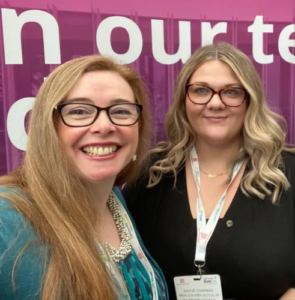
“Collective leadership is about shared and distributed leadership," says Kaylie. "We all have responsibility to take ownership and leadership for situations and see the possibility to get involved and be part of the solution."
Citing research from Bosch, B and Mansell, H (2015), Mary says trust and confidence are very important when it comes to real collaboration.
“Practitioners need to have confidence in their own abilities in order for other people to know that they can trust them and in order for other people to know that they’ve got confidence in their work,” she adds.
The research states one of the essential things for team success is the importance of role clarity, meaning each member of a team is trusted to execute their unique role. It also emphasises collective leadership.
“We’re in a really fortunate position that we have assistant team managers and experienced practitioners across our co-located teams who are OTs," says Kaylie.
“This supports us to have their professional specialism influencing, advising and supporting from the different management levels across adult social care."
Practical solutions
Social worker Hannah finds the multidisciplinary approach has helped her practice.
“Our OT colleagues are really helpful in terms of exploring all options and helping people to maintain their independence,” she says.
Hannah shares one story about an older adult she was supporting named Gail*. Gail suddenly became ill, and her care and support needs changed almost overnight, which resulted in an emergency increase in her care package.
The care agency could not sustain the level of support as double-handed care (two carers) was now needed four times a day.
The optimising care team, which is made up of OTs, helped by implementing special slide sheets that did not require two carers.
With training and support from the OT, the need for double-handed visits reduced to once a day, with a single carer carrying out the other three visits. Gail was able to stay in her home and the care agency was able to sustain the lower level of care.
“The OT had the expertise around the equipment and what was available to use, which we don’t have as social workers," says Hannah. "She also had the manual handling training, so she was able to train others in that manual handling which again, we don’t have. So that was really helpful."
Hannah started her career in Wiltshire Council on a student placement. She did her assessed and supported year in employment (ASYE) there and since then has stayed, despite not living locally.
“I was really grateful for the stability of Wiltshire [..] I work in a fantastic team.
I think the team can make or break this kind of work.“And, I think, particularly in a multidisciplinary team, having both occupational therapists and social workers in management means that we have a broad wealth of knowledge. And there’s always someone to go to for support, and we have an incredibly supportive management team.”
Comments from a feedback form by two practitioners at Wiltshire Council:
“Being part of a collaborative team means I always have support and can learn from others’ expertise.” (an OT)
“It is so helpful to have an assistant team manager who is an occupational therapist. She has a very good understanding of social work and occupational therapy. Sometimes she suggests things from a more occupational therapy angle which would not occur to me, and she enables urgent cases to be prioritised for OT involvement if required.” (a social worker)
Are you interested in a career with Wiltshire Council?
Find out more here or check out the latest vacancies.